Thursday, December 31, 2009

Blue Moon walks us into 2010

As the Blue moon walks us into 2010, its a good time to reflect the past year, but what exactly is the blue moon? lets have the reflection first then the blue moon ...

Shall we? thanks :)


2009, a year has past, new lessons learned, new experiences acquired, the world existed before I was born and so will it be when I would be laid to rest.
World does not need me for it to go on, for that there is Allah, then in this world no one would be left off without being tried and tested, would i be an exception? Nope sir that is not an option.

Amazing the way Allah has designed the test, so dynamic with varying conditions there is no point in life when he is not watching you, the angels recording you, I know we have no choice to opt out of this test.

But guys we are human beings and who does not like an easy question paper :). is there a way to get an easy test, there is "One who is satisfied with 'little' from Allah, HE would be satisfied with 'little' from them", there you go... easy way out of the test.

Again Mr, hello we are humans !!!, i mean like RAW humans!!!, to be satisfied with 'little' ? come on we live in the 21st century, and things Rock, IPod, XBox, 3D and what not ...

Well then face the test ....

We have a local myth here of a very generous king, he was known as Mahabali, he was so generous that even mythological 'gods' were jealous. So to teach this generous king a lesson Vamana asked for three feet of land and the king accepted, Vamana measured the entire world for the first two feets, for the third feet of land which the king did not have he offered his own head.

Again Mr, aren't you a muslim and narrating a mythological story!!!
Well yeah, I understand the culture of my neighbors, very much within the limits of Islam, thank you.

So I was saying, you would be tested, who knows what me have to offer???

So let me tell something from MUSLIM history just for you, there was a jew priest who wanted to test if Prophet Muhammed(SAWS) was really the one who claimed to be? In his scriptures it is mentioned that his forbearance and mercy would precede his anger.

Again Mr, where is the blue moon thingy?
Hold on am coming to that, shall i continue ...

The jew priest lend some money to the prophet, and before the lapse date of the debt to be paid back the Jew for testing the prophet showed anger, abused him and harshly demanded his money back. Hazrath Umar(RA) could not tolerate this sight and he unsheathed his sword and spoke rash words. To this prophet requested Umar(RA) to arrange the money as he himself did not have it at the time, and also asked Umar to pay extra for being rash to the priest. The priest got his sign.

Again Mr, what is the point?
Well we are the followers of the prophet, we would also be tested in similar ways and understand that the one actually testing us is ALLAH.
In 2010?
Year is immaterial !!!, and besides we have a lot of different new years just in this part of the world :)

So Mr, the blue moon?

Oh blue moon, see the calender we use is not lunar calendar and our calendar we use is really messed up, with 28,30,31 days. Now the moon cycle happens in approximately thirty days so there are some months where you would spot two New Moons.

Cool !!!

And this month and today night you can see the second full moon, and also there is an extra bonanza of lunar eclipse too today. We claim to have all the power and technology, can we cause an eclipse?

By the way how big are you?
Why Mr? am just an average Human
Compare all the humans put together on one side of the balance and moon on the other side from a size perspective, dont you think one who has power to eclipse the moon so easily can do the same with one and sundry?
Thought Provoking Mr


So Mr. but is there much of NIRVANA or NAJAAH into blue moon?

Why not? There is always NIRVANA or NAJAAH provided every sign you see makes you think and act on the right way.

You see skipper!!!, what ever reminds you that one day you are going to stand in front of your LORD and answer to him is worth noting in this world.
There is a Hadeeth which says 'Hasibu, Qabla an thuhasabu', "Take an account of yourself before you are taken to account for".
Imagine the grand setting of the world, HE is ensuring that you come good when your appointment with HIM is due.

OK Mr, got the point
Really??? if we really have ... would we be still living like this  ....?
So Mr you are not wishing me happy new year?
I wish you happiness always, not just on the new years eve :),And If i dont I fail in my test, and besides I am not what you call a party friendly person. I like gatherings for good causes.

Note from elders, before you go to sleep do the following things
1. Take an account of entire days deeds, if you find them good ask Allah to accept them, and you will find a lot of mistakes for which seek forgiveness
2. See if your heart has any rancor, enmity or hatred for any one, if you have then clear it, as heart is the abode of the beloved.

Thursday, December 24, 2009

Kerala High Court Stays Investigations

The Kerala high court has stayed further investigations into a matter of alleged 'forceful conversion'

read about it here or here or here

Islamic Role Models

My self and a few friends were visiting a buzurg ( a deeni elder ), 

During the wait a discussion spawned up, the topic being who is the role model for the Muslim's from the contemporary time frame.


The active discussion revolved around big names alive today including Uelema(Islami Scholars), Saintly elders, Kings, Mufties (the people who gives fatwa), Daees(people who invite towards islam).

Each name which came up for the discussions had exceptional qualities.

A person said "Look at this person(so and so) see how simple a life he is living"

Another said "This persons understanding of the Quraan and Sunna is so very clear, it makes much sense to me"

Another was quick to point out "See the impact of this particular persons speeches and discourses, it is really amazing"

Another noted "When i listen to the speeches of this person I get this strong inspiration to change and reform my self"

Another noted "And this guy, he is so cool that he has helped too many people already"

The points were vast, discussions open, then the discussion was narrowed down to a few names, until finally the deeni elder arrived.

"Assalamu Alaikum" we said, and he replied "walaikumussalam, wa rahmathullahi wa barakaathuhu"

"How are you folks doing, you seem to be in some kind of discussion prior to my arrival?"

One of us said that "we were in a discussion regarding contemporary people, who would be role models"

"Hmmmmm good topic, and who do you think it is?"

"Well we have narrowed down to few people"

The buzurug stated "We are not capable of deeming some one as role model, particularly those who are alive ..."

"Why is that hazrath?"

"For the simple reason that, no one knows the state of a person, to be precise in what way he/she is going to end up"

"Role models for us in our matters of deen is  those who have passed away in such a state that their deeds and actions are clear, Look at our prophet(SAWS), the companions of the prophet and the deeni elders who have passed away".

"Hazrath can you please make it clear for us?"

"Okay let me narrate to you a short incident of a great Aabid(a deeni person who is a humble slave of Allah) and how shaithan misguided him"

The Story
There was an Aabid, who spent his life in worship of Allah with such sincerity and devotion most people considered him to be a Wali of Allah (friend of Allah). Shaithaan's sole mission in life is to misguide people from the right path and his efforts are relentless. Shaithaan devised a cunning plan to misguide the Aabid, shaithaan took the form of a saintly elder and he began to spent his complete time in fake worship of Allah. The Aabid took a note of this new person in the masjid, who never went out for any need not even for food water or other necessities. This aspect astonished the Aabid as he wanted to attain such an 'enlightened state'. Finally he got a chance to talk to shaithaan in the form of the saintly elder.

"I am amazed at your capacity of worship, you do not even need food and water"
shaitaan replied "Yes it is a capacity i acquired, it is not easy to earn it"
"Oh please saintly elder, could you kindly let me also earn the state you have earned"
Shaitaan replied "It is a difficult path, but i can help you to acquire it, I have reached this state after experiencing all kinds of sins and then sincerely repenting from them"
"Okay, so where do i start?"
shaithaan replied "You can start from consuming aclohol"
"Ya allah, alcohol it is such a great sin, i cannot consume it"
shaithaan replied "Well then you cannot even dream of reaching the high state that i am in"

The Aabid started with aclohol, but consuming alcohol is the mother of all sins, gradually his life began to change until he came to his fateful end as one of the sinners who even lost their eeman.

The elder stopped narrating story, as he chuckled, his words broke a bit, i felt he might have thought of how good or bad his state of deeds would be, and not to say we all were in a similar state...

We did not conclude on the role model, the list no longer mattered, as we realized two things.

1. Our role models are those who have lived a life filled with virtuous deeds and activities and ended their life in the same way.
2. How futile is the effort to analyze contemporaries and judge them; the panelists(us)and the candidates are very unsure regarding the state of life down to the final moments here.

The elder advised further, having said that we are encouraged to seek good qualities in others and emulate them, this would help us improve. The role models are already in place, and it is not in our place to compete with them. It would be a great mercy from Allah if he finds any of our deeds as worthy and so would it be to get his forgiveness for our shortcomings.

And be sure that you dont look at shortcomings of others, so that you might feel superior to others in any way, for when you feel superior to others then begins your downfall. Remember the downfall of shaithaan he claimed that he was better than Adam(AS) for Adam(AS) was made from mud and shaithan was built from fire. This superiority feeling led him to be arrogant and disobeying the commands of the lord who created him. Once he desobeyed he became shaithaan-ar-rajeem(shaithaan the cursed).


Keep learning, Keep Striving, for Allah watches with kindness the efforts of those who seek his way.

Friday, December 18, 2009

Wikepedia Donation Drive - Jimmy Wales, Founder of Wikipedia

Dear Netizens

The impact of wikipedia and the support that a person is able to get as a netizen is enormous.


When Jimmy says "Imagine a world in which every single person on the planet has free access to the sum of all human knowledge. That’s where we’re headed. And with your help, we will get there."

I believe and understand that it is a cause worth spending on, there was a time when the knowledge spread accross different cultures and contintents where translated and preserved in arabic, if it was not done during that time most of the works of art and science from such sources would have been lost and not recognized.


you can contribute here 

Thursday, December 17, 2009

Four Management Lessons

Lesson Number One

A crow was sitting on a tree, doing nothing all day. A small rabbit saw the crow, and asked him, "Can I also sit like you and do nothing all day long?"


The crow answered: "Sure, why not."

So, the rabbit sat on the ground below the crow, and rested. All of a sudden, a fox appeared, jumped on the rabbit and ate it.

Management Lesson: To be sitting and doing nothing, you must be sitting very, very high up.


Lesson Number Two

A turkey was chatting with a bull.

"I would love to be able to get to the top of that tree," sighed the turkey, "but I haven't got the energy. "Well, why don't you nibble on some of my droppings?" replied the bull. "They're packed with nutrients."

The turkey pecked at a lump of dung and found that it actually gave him enough strength to reach the first branch of the tree. The next day, after eating some more dung, he reached the second branch. Finally after a fortnight, there he was proudly perched at the top of the tree. Soon he was promptly spotted by a farmer, who shot the turkey out of the tree.


Management Lesson: Bullshit might get you to the top, but it won't keep you there.


Lesson Number Three

When the body was first made, all the parts wanted to be Boss. The brain said, "I should be Boss because I control the whole body's responses and functions."

The feet said, "We should be Boss as we carry the brain about and get him to where he wants to go." The hands said, "We should be the Boss because we do all the work and earn all the money." And so it went on and on with the heart, the lungs and the eyes until finally the asshole spoke up.

All the parts laughed at the idea of the asshole being the Boss. So the asshole went on strike, blocked itself up and refused to work. Within a short time the eyes became crossed, the hands clenched, the feet twitched, the heart and lungs began to panic and the brain fevered. Eventually they all decided that the asshole should be the Boss, so the motion was passed.

All the other parts did all the work while the Boss just sat and passed out the shit!

Management Lesson: You don't need brains to be Boss, any asshole will do!


Lesson Number Four

A little bird was flying south for the winter. It was so cold, the bird froze and fell to the ground in a large field. While it was lying there, a cow came by and dropped some dung on it. As the frozen bird lay there in the pile of cow dung, it began to realize how warm it was. The dung was actually thawing him out!

He lay there all warm and happy, and soon began to sing for joy. A passing cat heard he bird singing and came to investigate. Following the sound, the cat discovered the bird under the pile of cow dung, and promptly dug him out and ate him!

Management Lessons:

1. Not everyone who drops shit on you is your enemy.
2. Not everyone who gets you out of shit is your friend.
3. When you're in deep shit, keep your mouth shut!

Climate Treaty Copenhagen

World eagerly awaits for a treaty that would address to safeguard and protect the environment and hence the climate, greenpeace and others are on a 'jihad' to make sure it happens. Despite the dignitaries coming together for this cause, people who are involved still are not expecting  a sensible outcome but what they are hoping for is a miracle to happen. Has the matter of things been degraded to such a level that only miracles can solve the issue?

Lets look at the issue at hand here, in a pictorial way
 

We all human beings are driven by our needs, desires and other activities which impact the world we live in, so there is your cause and there is your effect.

Today we are driven by our own selfish desires, which unfortunately do not care much about the impact that it makes, like shown below.

Today we are driven by our selfish goals, we are not ready to make some sacrifices and be a little selfless in our matters to reach a consensus for general well being, and yet we expect a miracle, how can it happen as our creator says
30:41. Mischief has appeared on land and sea because of (the meed) that the hands of men have earned, that ((Allah)) may give them a taste of some of their deeds: in order that they may turn back (from Evil). 
 We keep thinking "What do I need right now?", for which we look deep into our own self and seek out our selfish desires which we think would make us happy. Despite this we expect a miracle could it happen???

Lets look a bit below and think.

Now if we were to look at things from a different perspective, and ask this question to ourself "what does my creator want from me right now? which would bring benefit to all?". When the answer is provided from the source of right guidance you perform an internal 'jihad' to suppress your selfish ends and be selfless in your deeds. Those deeds would be recognized by Allah and he would sent down his commands, his miracle for us.

Without changing our ways and expecting for a miracle? come on welfare for humanity is not cheap.

Glossary::
Sahaba - The rightly guided companions of the prophet(SAWS)
Hadeeth/Sunna - Traditions and sayings of the holy prophet(SAWS)

Friday, December 11, 2009

SOA Standards & Building Blocks

SOA is dependent on standards to achieve interoperability and flexibility. It is vital for an SOA architect to have a dashboard that acts as a reference to the various technology standards.

This is such a reference deck, to see which all standards you need to know, whether it is for Solution design, implementation, consultancy or even certification. Click on each standards for details.
WS-I
WSDM
BPEL
WSRP
WS-Transaction
WS-Coordination
WSDM
WS-Security
WS-Trust
WS-Federation
WS-SecureConversation
WS-SecurityPolicy
WS-Provisioning
WS-Privacy
WS-Reliable
Messaging

WSDL
UDDI
WS-Policy
WS- Discovery
SOAP,SOAP
Attachments
WS-Addressing, WS-Notification
JMS,
RMI, IIOP etc

Thursday, December 10, 2009

SOA Building Blocks WSRP

Integration of remote content and application logic into an End-User presentation has been a task requiring significant custom programming effort. Typically, vendors of aggregating applications, such as a portal, write special adapters for applications and content providers to accommodate the variety of different interfaces and protocols those providers use. The goal of this specification is to enable an application designer or administrator to pick from a rich choice of compliant remote content and application providers, and integrate them with just a few mouse clicks and no programming effort. This revision of the specification adds Consumer managed coordination, additional lifecycle management and a set of related aggregation enhancements.

This specification is the effort of the OASIS Web Services for Remote Portlets (WSRP) Technical Committee which aims to simplify the effort required of integrating applications to quickly exploit new web services as they become available.

This standard layers on top of the existing web services stack, utilizing existing web services standards and will leverage emerging web service standards (such as policy) as they become available. The interfaces defined by this specification use the Web Services Description Language (WSDL).

Read more here

SOA Building Blocks WS-Privacy

Organizations create, manage and use web services. These organizations need to state their privacy policies.
They also need to require that incoming requests adhere to these policies

SOA Building Blocks WS-I

The Web Services Interoperability Organization (WS-I) is an industry consortium chartered to promote interoperability amongst the stack of web services specifications. WS-I does not define standards for web services; rather, it creates guidelines and tests for interoperability.

Read about - profile1-2
Read about - profile 1-1

SOA Building Blocks WS-Notification

WS-Notification is a family of related white papers and specifications that define a standard Web services approach to notification using a topic-based publish/subscribe pattern.

The Event-driven, or Notification-based, interaction pattern is a commonly used pattern for inter-object communications. Examples exist in many domains, for example in publish/subscribe systems provided by Message Oriented Middleware vendors, or in system and device management domains. This notification pattern is increasingly being used in a Web services context.

WS-Notification is a family of related white papers and specifications that define a standard Web services approach to notification using a topic-based publish/subscribe pattern. It includes:

    * Standard message exchanges to be implemented by service providers that wish to participate in Notifications
    * Standard message exchanges for a notification broker service provider (allowing publication of messages from entities that are not themselves service providers)
    * Operational requirements expected of service providers and requestors that participate in notifications
    * An XML model that describes topics.

There are two forms of notification specs one is for the BaseNotification other for the brokered notification.

Read more here

SOA Building Blocks WS-Addressing

Web Services Addressing (WS-Addressing) defines two interoperable constructs that convey information that is typically provided by transport protocols and messaging systems. These constructs normalize this underlying information into a uniform format that can be processed independently of transport or application. The two constructs are endpoint references and message information headers.

A Web service endpoint is a (referenceable) entity, processor, or resource where Web service messages can be targeted. Endpoint references convey the information needed to identify/reference a Web service endpoint, and may be used in several different ways: endpoint references are suitable for conveying the information needed to access a Web service endpoint, but are also used to provide addresses for individual messages sent to and from Web services. To deal with this last usage case this specification defines a family of message information headers that allows uniform addressing of messages independent of underlying transport. These message information headers convey end-to-end message characteristics including addressing for source and destination endpoints as well as message identity.

Both of these constructs are designed to be extensible and re-usable so that other specifications can build on and leverage endpoint references and message information headers.

Read more here

SOA Building Blocks WS-Discovery

This specification defines a multicast discovery protocol to locate services. The primary mode of discovery is a client searching for one or more target services. To find a target service by the type of the target service, a scope in which the target service resides, or both, a client sends a probe message to a multicast group; target services that match the probe send a response directly to the client. To locate a target service by name, a client sends a resolution request message to the same multicast group, and again, the target service that matches sends a response directly to the client.
To minimize the need for polling, when a target service joins the network, it sends an announcement message to the same multicast group. By listening to this multicast group, clients can detect newly-available target services without repeated probing.
To scale to a large number of endpoints, this specification defines multicast suppression behavior if a discovery proxy is available on the network. Specifically, when a discovery proxy detects a probe or resolution request sent by multicast, the discovery proxy sends an announcement for itself. By listening for these announcements, clients detect discovery proxies and switch to use a discovery proxy-specific protocol. However, if a discovery proxy is unresponsive, clients revert to use the protocol described herein.
To support networks with explicit network management services like DHCP, DNS, domain controllers, directories, etc., this specification acknowledges that clients and/or target services may be configured to behave differently than defined herein. For example, another specification may define a well-known DHCP record containing the address of a discovery proxy, and compliance with that specification may require endpoints to send messages to this discovery proxy rather than to a multicast group. While the specific means of such configuration is beyond the scope of this specification, it is expected that any such configuration would allow clients and/or target services to migrate smoothly between carefully-managed and ad hoc networks.

Read More Here

SOA Building Blocks WS-Policy

WS-Policy is a specification that allows web services to use XML to advertise their policies (on security, Quality of Service, etc.) and for web service consumers to specify their policy requirements.

WS-Policy provides a flexible and extensible grammar for expressing the capabilities, requirements, and general characteristics of entities in an XML Web services-based system. WS-Policy defines a framework and a model for the expression of these properties as policies.

WS-Policy defines a policy to be a collection of policy alternatives, where each policy alternative is a collection of policy assertions. Some policy assertions specify traditional requirements and capabilities that will ultimately manifest on the wire (e.g., authentication scheme, transport protocol selection). Other policy assertions have no wire manifestation yet are critical to proper service selection and usage (e.g., privacy policy, QoS characteristics). WS-Policy provides a single policy grammar to allow both kinds of assertions to be reasoned about in a consistent manner.

WS-Policy does not specify how policies are discovered or attached to a Web service. Other specifications are free to define technology-specific mechanisms for associating policy with various entities and resources. WS-PolicyAttachment [WS-PolicyAttachment] defines such mechanisms, especially for associating policy with arbitrary XML elements, WSDL artifacts, and UDDI elements. Subsequent specifications will provide profiles on WS-Policy usage within other common Web service technologies.

Read more here

SOA Building Blocks WS-Reliable Messaging

This specification (WS-ReliableMessaging) describes a protocol that allows messages to be delivered reliably between distributed applications in the presence of software component, system, or network failures.

Many errors may interrupt a conversation. Messages may be lost, duplicated or reordered. Further the host systems may experience failures and lose volatile state.
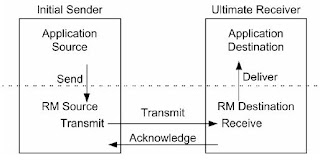
WS-ReliableMessaging provides an interoperable protocol that a Reliable Messaging (RM) Source and Reliable Messaging (RM) Destination use to provide Application Source and Destination a guarantee that a message that is sent will be delivered. The guarantee is specified as a delivery assurance. The protocol supports the endpoints in providing these delivery assurances. It is the responsibility of the RM Source and RM Destination to fulfill the delivery assurances, or raise an error. The protocol defined here allows endpoints to meet this guarantee for the delivery assurances defined below.
Persistence considerations related to an endpoint's ability to satisfy the delivery assurances defined below are the responsibility of the implementation and do not affect the wire protocol. As such, they are out of scope of this specification.


There are four basic delivery assurances that endpoints can provide:
AtMostOnce Messages will be delivered at most once without duplication or an error will be raised on at least one endpoint. It is possible that some messages in a sequence may not be delivered.
AtLeastOnce Every message sent will be delivered or an error will be raised on at least one endpoint. Some messages may be delivered more than once.
ExactlyOnce Every message sent will be delivered without duplication or an error will be raised on at least one endpoint. This delivery assurance is the logical "and" of the two prior delivery assurances.
InOrder Messages will be delivered in the order that they were sent. This delivery assurance may be combined with any of the above delivery assurances. It requires that the sequence observed by the ultimate receiver be non-decreasing. It says nothing about duplications or omissions.

Read more here

SOA Building Blocks WSDM

WSDM specification (MUWS) defines how the ability to manage, or how the manageability of, an arbitrary resource can be made accessible via Web services. In order to achieve this goal, MUWS is based on a number of Web services specifications, mainly for messaging, description,discovery, accessing properties, and notifications.

A Web service endpoint provides access to a manageable resource. An example of a manageable resource is a printer that has the capability to alert when its toner is low, or, a magnetic storage disk that reports its internal temperature in the form of a web service operation. A manageability consumer discovers the Web service endpoint and exchanges messages with the endpoint in order to request information, subscribe to events, or, control the manageable resource associated with the endpoint. An example of a manageability consumer is a management system, or, a business automation process, or simply, any Web service application.


In order to discover the Web service endpoint providing access to a particular manageable resource, a manageability consumer first obtains an Endpoint Reference (EPR), as defined by the WS-Addressing specification [WS-Addressing], and then obtains any other required descriptions, including, but not limited to, a WSDL document [WSDL], an XML Schema, or a policy document. MUWS uses the same mechanisms for obtaining EPRs and their associated descriptions as used by regular Web service implementations.
A Web service endpoint providing access to some manageable resource is called a manageability endpoint. To exchange messages with a manageability endpoint, a manageability consumer needs to understand all of the required descriptions for the endpoint. The manageability consumer sends messages targeted to the manageable resource by using information contained in the EPR, for example, an address and some reference properties (see [WS-Addressing]).

SOA Building Blocks WS-Provisioning

WS-Provisioning describes the APIs and schema necessary to facilitate interoperability between provisioning systems and to allow software vendors to provide provisioning facilities in a consistent way. The specification addresses many of the problems faced by provisioning vendors in their use of existing protocols, commonly based on directory concepts, and confronts the challenges involved in provisioning Web services described using WSDL and XML Schema. The WS-Provisioning interface is an open standard that is available to other companies that want to develop interoperable provisioning scenarios and systems.

Read more about it Here

SOA Building Blocks WS-SecurityPolicy

The Web Services Security Policy Language (WS-SecurityPolicy) specification defines a set of security policy assertions that apply to Web Services Security: SOAP Message Security, WS-Trust, and WS-SecureConversation. This specification takes the approach of defining a base set of assertions that describe how messages are to be secured. Flexibility with respect to token types, cryptographic algorithms, and mechanisms used, including using transport-level security, is part of the design and allows for evolution over time. The intent is to provide enough information for compatibility and interoperability to be determined by Web services participants, along with all information necessary to actually enable a participant to engage in a secure exchange of messages.

Read More Here

SOA Building Blocks WS-SecureConversation

The Web Services Secure Conversation Language (WS-SecureConversation) is built on top of the WS-Security and WS-Policy models to provide secure communication between services. WS-Security focuses on the message authentication model, but not a security context, and thus is subject to several forms of security attacks. This specification defines mechanisms for establishing and sharing security contexts, and deriving keys from security contexts, to enable a secure conversation.

By using the SOAP extensibility model, modular SOAP-based specifications are designed to be composed with each other to provide a rich messaging environment. Therefore, WS-SecureConversation by itself does not provide a complete security solution. WS-SecureConversation is a building block that is used in conjunction with other Web service and  application-specific protocols (for example, WS-Security) to accommodate a wide variety of security models and technologies.

Read More Here

SOA Building Blocks WS-Federation


WS-Federation describes how to use the existing Web services security building blocks to provide federation functionality, including trust, single sign-on (and single sign-off), and attribute management across a federation. WS-Federation is really a family of three specifications: WS-Federation, WS-Federation Passive  Client, and WS-Federation Active Client.
WS-Federation itself describes how to implement a federation in a Web services world. In particular, WS-Federation focuses on the relationships between parties and the high-level architecture that supports these relationships. The two individual documents, WS-Federation Active and WS-Federation Passive, describe how to implement individual federation solutions.

WS-Federation Active describes how to implement federation functionality in the active client environment. Active clients are those that are Web services-enabled, that is, able to issue Web services requests and react to a Web services response. Leveraging the Web services security stack, WS-Federation Active describes how to implement the advantages of a federation relationship, including single sign-on, in an active client environment. WS-Federation Passive describes how to implement federation functionality in a passive client environment. A passive client is one that is not Web services-enabled.

The most commonly encountered example of a passive client is a vanilla HTTP browser. WS-Federation Passive describes how to leverage the advantages of a federation relationship such as single sign-on in a passive client environment. Because this solution leverages the WS-Security foundation of the infrastructure support, the same components used to provide a passive client solution can be leveraged for an active client solution.


The models defined in [WS-Security], [WS-Trust], and [WS-Policy] provides the basis for federated trust. This specification extends this foundation by describing how these models are combined to enable richer trust realm mechanisms across and within federations. This section describes different trust topologies and how token exchange (or mapping) can be used to broker the trust for each scenario.

Read more Here

SOA Building Blocks WS-Trust

The Web Services Trust Language (WS-Trust) uses the secure messaging mechanisms of WS-Security to define additional primitives and extensions for the issuance, exchange, and validation of security tokens. WS-Trust also enables the issuance and dissemination of credentials within different trust domains. In order to secure a communication between two parties, the two parties must exchange security credentials (either directly or indirectly). However, each party needs to determine if they can trust the asserted credentials of the other party. This specification defines extensions to WS-Security for issuing and exchanging security tokens and ways to establish and access the presence of trust relationships.


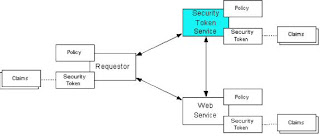
The Web service security model defined in WS-Trust is based on a process in which a Web service can require that an incoming message prove a set of claims (e.g., name, key, permission, capability, etc.). If a message arrives without having the required proof of claims, the service SHOULD ignore or reject the message. A service can indicate its required claims and related information in its policy as described by [WS-Policy] and [WS-PolicyAttachment] specifications.

Read Details Here

SOA Building Blocks WSS(WS-Security)

WS-Security describes enhancements to SOAP messaging to provide quality of protection through message integrity, message confidentiality, and single message authentication. These mechanisms can be used to accommodate a wide variety of security models and encryption technologies.

The protocol contains specifications on how integrity and confidentiality can be enforced on Web services messaging. The WSS protocol includes details on the use of SAML and Kerberos, and certificate formats such as X.509.

The WS-Security specification provides message-level security. The advantage of using WS-Security instead of Secure Sockets Layer (SSL) is that it can provide end-to-end message level security. This means that the messages are protected even if the message goes through multiple services, or intermediaries. Additionally, WS-Security is independent of the transport layer protocol. It can be used for any SOAP binding, not just for SOAP over HTTP.

SOA Building Blocks WS-Coordination

WS-Coordination
This specification describes an extensible framework for providing protocols that coordinate the actions of distributed applications. Such coordination protocols are used to support a number of applications, including those that need to reach consistent agreement on the outcome of distributed activities.
The framework defined in this specification enables an application service to create a context needed to propagate an activity to other services and to register for coordination protocols. The framework enables existing transaction processing, workflow, and other systems for coordination to hide their proprietary protocols and to operate in a heterogeneous environment.
Additionally this specification describes a definition of the structure of context and the requirements for propagating context between cooperating services.
 
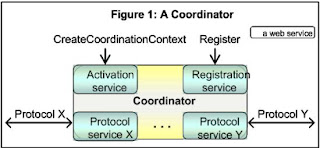
 Applications use the Activation service to create the coordination context for an activity. Once a coordination context is acquired by an application, it is then sent by whatever appropriate means to another application.  The context contains the necessary information to register into the activity specifying the coordination  behavior that the application will follow. Additionally, an application that receives a coordination context may use the Registration service of the original application or may use one that is specified by an interposing, trusted coordinator. In this manner an arbitrary collection of Web services may coordinate their joint operation.

Readup - OASIS or IBM or Wikipedia

Wednesday, December 9, 2009

SOA Building Blocks WS-Transaction

Services within the realm of SOA could be located within an enterprise our outside it, a business process that spans within as well as outside the enterprise would not normally have a session that binds these spanned processes together. What if your account gets debited and the bill is not paid, well ... you can call the customer care and
ask them "why is my bill not paid while my account is debited?"
and the reply would be "Sir you need to wait 24 hours so that the amount is rolled back/or forward",
then you call them after 24 hours and tell them "You said 24 hours my account is still not updated.."
and they reply "Sir it is 24 WORKING HOURS ..."


well you get the picture, this is about transactions across disparate systems and environments. This is why and where WS-Transactions come into picture.

look at the specs here

and a artilce here and here 

Building Blocks of SOA - BPEL

Any business is a set of processes which culminate in delivery of goods or services and generating revenue in exchange.
SOA provides a technical blueprint with the business to deliver goods/services and generate revenue.

Let us take a following flow
1 - The simple shop process starts, when a customer sends a shopping cart and a user ID.

2 - The process requires the delivery address and the credit card number of the customer.
The information is sent in two different messages, which may arrive in an arbitrary sequence.

3 - Finally the customer finishes the process and the shopping information is logged.


It is possible to make it into a code, write objects, functions and procedures to make this happen.

In SOA world we use a different form of coding its called BPEL, the content, variables flow all defined within XML-

get details here

lets look at a simple variable definition

Like wise these the content could be any of these <receive><reply><invoke><assign><throw><exit><wait><empty><sequence><if><while><repeatUntil><forEach><pick><flow><scope><compensate><compensateScope><rethrow><validate> instead of <variable>
If you really want to get your hands dirty, try out these Business Process Management Samples from IBM, which case you can do the stuff without getting your hands too much dirty.