Posts

Showing posts with the label Technology

The Agentic Architecture: How to Scale Velocity Without Sacrificing Reliability

Image
The Agentic Architecture: How to Scale Velocity Without Sacrificing Reliability In the transition from traditional coding to AI-augmented development, engineering velocity is no longer the primary constraint. With GitHub Copilot and agentic workflows, we can now manifest architecture into code at unprecedented speeds. The Core Thesis: As AI accelerates delivery, it also amplifies Architectural Drift . In an AI-first world, discipline isn't a hurdle—it’s the only scalable advantage. I. The Executive Perspective: Governance at Scale For leadership, moving to agentic AI means shifting from Manual Oversight to Automated Guardrails . When agents generate thousands of lines of code in seconds, human "eyes-on-code" becomes a bottleneck, not a safety net. Legacy Operating Model Agentic Operating Model Documentation is a lagging artifact Documentation is a required, generat...

I Gave My Smart Home a Brain: OpenClaw AI Agent on Raspberry Pi 5 + Home Assistant (2026)

🦞 Field-tested guide · March 2026 I Gave My Smart Home a Brain: OpenClaw AI Agent on Raspberry Pi 5 + Home Assistant (2026) A complete, honest guide to setting up an always-on AI agent alongside HAOS — with every gotcha we hit along the way documented. 🥧 Raspberry Pi 5 🏠 Home Assistant OS 🤖 Claude Sonnet 4.6 ✈️ Telegram Audience: 🟢 Beginner Anyone can follow 🟡 Intermediate Basic Linux helpful 🟣 Advanced Docker/HA internals useful ⚠️ Security Pay close attention 1 Prerequisites 2 Install 3 Security 4 Skills & Tips 5 Lessons Before You Begin 📋 Everything you need to prepare before touching Home Assistant. Getting these ready first means the actual install takes under 20 minutes. 🟢 Beginner Why Can't I Just Install OpenClaw Directly on the Pi? Home Assistant OS (HAOS) is a locked-down, read-only operating system. Unlike regular Linux, you can...

Flutter Limit Re-Buiild to An Inner Widget

Image
Problem : When creating a UI in Flutter, it can be challenging to rebuild specific widgets without impacting the performance of the entire page. In some cases, expensive widgets may need to be rebuilt unnecessarily, which can slow down the app's overall performance. Solution : To address this issue, you can use the StatefulBuilder widget in Flutter. This allows you to limit the rebuild to only the inexpensive widgets, while expensive widgets are only rebuilt when necessary. By wrapping the inexpensive widget inside a StatefulBuilder, you can avoid the need to repaint the entire page and improve the app's overall performance. This approach is a simple and effective way to optimize the app's performance and ensure a smooth user experience.  You can limit the rebuild to the inexpensive widget by wrapping it inside a StatefulBuilder. While the expensive widget is only rebuilt when its needed.  The sample code is given below.

The language of EA or لغة البنية المؤسسية

Image
Enterprise architecture is a global practice, has to be considered as such and yet to act local, knowing the language of EA in local context is vital. Either for engaging with global communities or SMEs or for communicating with your immediate stakeholders, one must not be short for words. So here is an attempt to share some of those words. Establishing purpose (غرض) of having the EA Office (مكتب البنية المؤسسية) depends on your key stakeholders (أصحاب المصلحة) especially the executives (المدراء التنفيذيين). Some priorities (الأولويات) when you get started are … Creating a shared vision (رؤية), objectives (الأهداف) … understanding customers and the value proposition (عرض القيمة) that you can deliver, and hence setting up your EA Strategy and Operating Model (نموذج التشغيل) … communicating clearly, concisely, consistently the EA value, via an EA Awareness Plan (خطة للحملة التوعوية للبنية المؤسسية) and having a clear EA Communication plan (خطة التواصل للبنية المؤسسية) etc. In parallel se...

National Enterprise Architecture - Application and Journey

Image
January 2018, at the First National Enterprise Architecture (NEA) Conference, his Excellency Eng. Abdullah Al-Swaha, set the broad mandate of NEA  “To reinforce the concept of Enterprise Architecture, and the importance of its adoption in the sector for accelerating the digital transformation of government entities, raising the Kingdom’s ranking in the UN e-Government Development Index and realizing Saudi Arabia’s Vision of 2030” Since the establishment of NEA for Kingdom of Saudi Arabia, it has been an un-written prime directive to accelerate, facilitate and enable the advancement and progress of this dynamic and ever evolving great nation. NEA offers its capability and expertise in visualizing whole of government, and then being able to plan, analyze, optimize and govern the nation’s ICT in realizing the vision of 2030. NEA Journey Marsad NEA rolled out the world’s first whole of government service repository called Marsad. The application...

Impact of Automation on Society, Jobs and Economy

Image
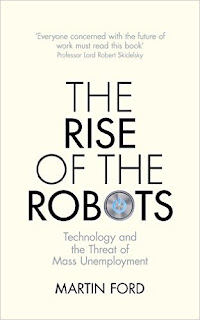
Finished reading this book, The Rise of the Robots: Technology and the Threat of Mass Unemployment by Martin Ford, the conclusion leaves the reader with many take away's. Hence this write up is going to be, a synergy of what comes from the book as well as thoughts on the topic from learning of the past.  The different facets of the book including the Moores law that predicts the doubling of processing, the instance of automation and self learning algorithms, of the influence of capital on labor, the impact of automation on the middle classes, the manual laborers, the possible scarcity of disposable income and hence how demand would impact profits/loss, to name a few. The case of a fully automated sushi shop, where automation replaces the cook, the waiter, etc. leaves a vivid image about the possibilities of automation. The algorithm that can write sports narrative as good as any sports writer capturing the nuances of sports reporting. IBM computer Watson beating Jeopar...

The Rise of the Robots: Technology and the Threat of Mass Unemployment

Image
The book, The Rise of the Robots: Technology and the Threat of Mass Unemployment by Martin Ford is an interesting read. Hinged around the Moores law that predicts the doubling of processing power every year, and compares growth in automation that has happened in the past to the events in the present and a possible near future. And No! its not a work of fiction. The book takes a look at impact of processing power and innovation around it in varying layers, of economy, labor market, education. The automation has indeed replaced jobs in certain sectors, given example and implications of each. A the book keeps saying automation is going to replace humans in many fields and the readers mind keeps debating it, arguing as the book itself says "No robots cant replace humans...period". As I keep reading the zone of that wishful thinking begin to shrink gradually, but not yet entirely given up on the debate, i find my self reading on and debating on. I haven't finished th...